

SFDR
SFDR website disclosure Vesteda Residential Fund
Summary
Vesteda Residential Fund promotes environmental characteristics, being climate change mitigation and adaptation. Climate change mitigation is attained by reducing the energy consumption of its real estate properties. Climate change adaptation is achieved by using a physical climate risk assessment to reduce high risk investments to low / medium climate-risk. Although sustainable investments are not the objective of the Fund, the Fund partially engages in sustainable investments. The Fund aims to achieve 65% sustainable investments. The Fund ensures that these sustainable investments do not significantly harm any other environmental or social objectives. The Fund’s overall long-term objective is to achieve a near-energy-neutral portfolio (also called Paris-proof aligned) by the end of 2050.
All investment proposals include a sustainability impact score, to ensure continuous alignment with the Fund’s environmental characteristics. To measure the attainment of the environmental characteristics, the Fund assesses the energy labels of its real estate, the average kWh per m2 and the share of investments with a low or medium climate-risk. Vesteda predominantly obtains the information directly from the properties, however there are certain limitations certain limitations exist in data collection. Engagement is not part of the environmental or social investment strategy, as Vesteda does not invest in other companies.
No sustainable investment objective
This financial product promotes environmental or social characteristics but does not have as its objective sustainable investment. The financial product invests partially in sustainable investments. A sustainable investment is an investment in an economic activity that contributes to an environmental or social objective. The Fund invests in sustainable investments with a climate mitigation objective by investing in energy efficient real estate and/or by implementing measures to improve the energy efficiency of existing investments.
The Fund’s real estate assets are not involved in the extraction, storage, transport or manufacture of fossil fuels and therefore comply with the criteria set out in Table 1 of Annex I (sub 17). Furthermore, Vesteda has set thresholds for indicator 18 of Table 1 of Annex I and for the relevant adverse sustainability indicators set out in Table 2 of Annex I of the SFDR Delegated Regulation (EU) 2022/1288. Vesteda has identified which indicators are relevant for assessing significant harm and for which sufficient robust data or proxies are available. Vesteda ensures that these thresholds are not exceeded in order to avoid significant harm. The OECD Guidelines for Multinational Enterprises and the UN Guiding Principles on Business and Human Rights are not applicable for the purpose of this reporting, as the Fund invests directly in real estate and not in companies.
Environmental or social characteristics of the financial product The product promotes environmental characteristics. Specifically, it promotes climate change mitigation by reducing the energy consumption of its real estate portfolio. Vesteda takes several measures to reduce the energy consumption of its portfolio.
Investment strategy
The Fund invests in residential real estate. The Fund’s overall long-term objective is to achieve a near-energy-neutral portfolio (also called Paris-proof aligned) by the end of 2045. The Fund promotes environmental characteristics. The promoted environmental characteristics are met through the achievement of the set targets on climate mitigation and climate adaptation. The Fund’s strategy is based on the Investment Guidelines as set out in the Fund’s Terms and Conditions. The strategic principles form the basis for an annual Business Plan, which must be approved by the Fund’s participants. The approved Business Plan, in turn, forms the basis for the annual strategy, including investments.
The main performance goals set out in the most recent Business Plan include:
- A reduction in energy consumption in KWh/m of ≈ 60% by 2030 (compared to 1990) to be achieved through adding extra insulation measures linked to maintenance activities and improvements to the high energy consuming assets.No assessment of good governance is performed, as the Fund does not invest in investee companies but only directly in real estate properties.
Proportion of investments
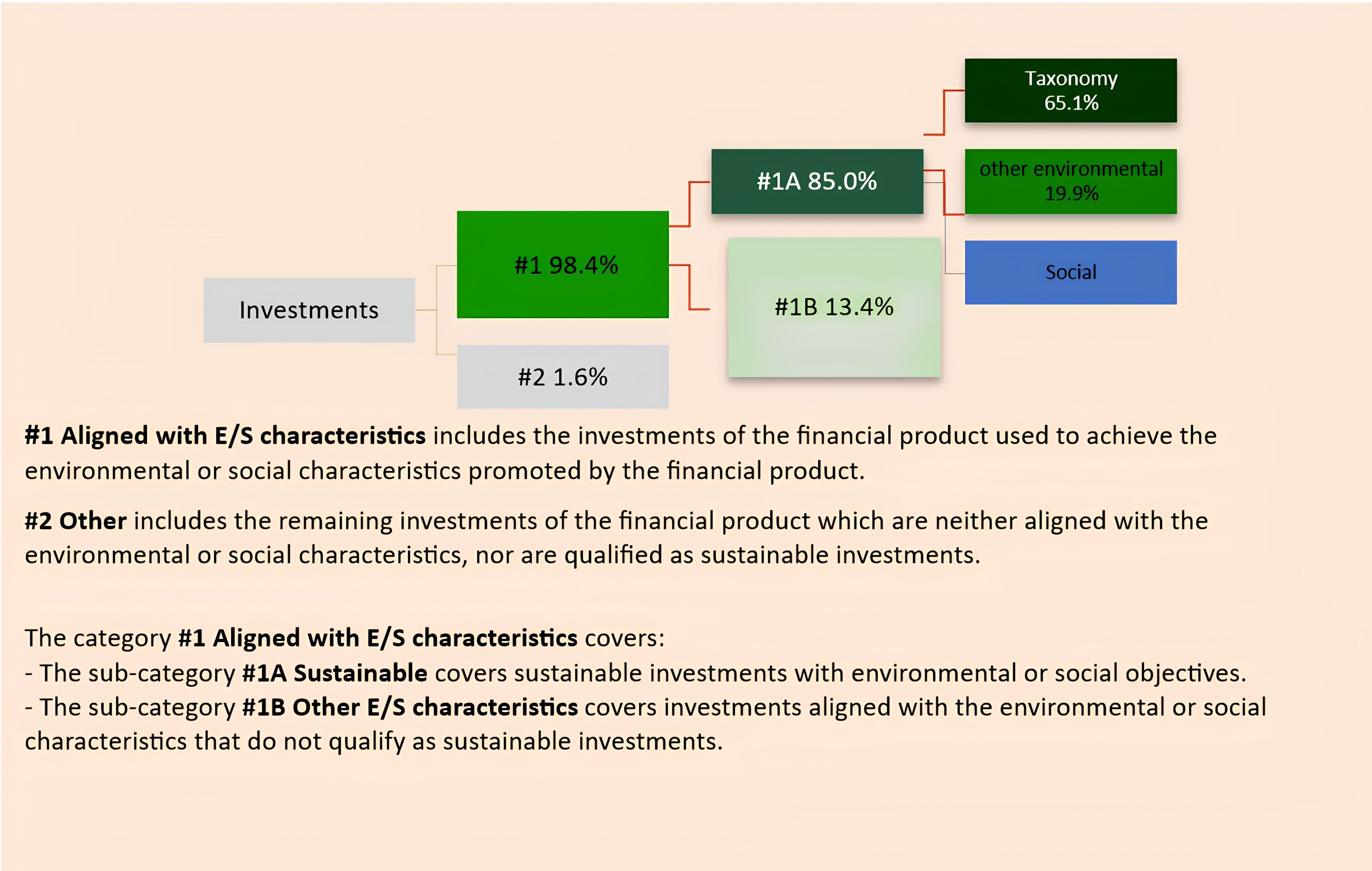
In total, 98,4% of investments consist of direct investments in real estate properties and are aligned with the environmental characteristics of the product. Overall, 85% of the investments qualify as sustainable investments under the SFDR, of which 65.1% are taxonomy aligned.
Monitoring of environmental or social characteristics
To achieve the energy reduction target, Vesteda has developed a CO2 Roadmap, in line with government targets. To achieve this target, Vesteda integrates its sustainability improvement plans into technical standards that are applied when acquiring, renovating and maintaining real estate assets. Vesteda applies its technical standards to assess whether (potential) investments comply with Vesteda’s sustainability and technical requirements. In some cases, these standards exceed national and local laws and regulations and also take into account the Technical Screening Criteria for climate change mitigation and adaptation under the EU Taxonomy Regulation. In addition, Vesteda uses an ESG risk-framework to determine a sustainability impact score for each new-build or renovation project. This contributes to a broader assessment of relevant sustainability risks and factors. As a result, each potential project is assigned a sustainability impact score based on various indicators. Reporting and monitoring takes place after project completion. At this stage, the property has been completed, rented out and is operational. Vesteda monitors the performance and impact of sustainability factors. This is conducted by collecting data from the properties and performing property performance tests. The results thereof, together with the benchmarks outcome, provide input for investments decision making and may result in adjustments to Vesteda’s ESG Framework and Technical Standards.
Methodologies for environmental or social characteristics
When applying the methodologies to select the additional indicators, Vesteda strives, to the extent possible, to use science-based targets. These targets provide a clearly defined pathway for companies to reduce greenhouse gas emissions, helping prevent the worst impacts of climate change and future-proof business growth. Targets are considered ‘science-based’ when they align with the latest climate science on what is required to meet the goals of the Paris Agreement – limiting global warming to well below 2°C above pre-industrial levels and pursuing efforts to limit warming to 1.5°C. The focus is on indicators that Vesteda can influence as owner of the real estate assets; in that regard, energy consumption intensity is considered the most suitable indicator.
The Fund uses the following sustainability indicators to assess whether the promoted environmental characteristics are achieved:
- Energy consumption intensity: average energy use expressed in kWh per m2
- Green labels: percentage of investments with a green energy label (A, B, C)
- Climate risk exposure: Share of investments in market value where no or a low to medium climate risk has been identified
Data sources and processing
Energy consumption intensity: data provided by energy companies and grid operators.
Energy labels: energy labels are assigned in accordance with the EU Energy Performance of Buildings Directive. The energy labels are determined using the calculation method NTA 8800. This method applies to both existing and new buildings. A certified external party assesses the relevant real estate asset and registers its characteristics in EP-online, the official Dutch database for energy indicators and labels. The database can be consulted to retrieve the energy label of a specific housing unit.
Climate risk exposure: To assess whether no or only a low to medium climate risk is present, Vesteda has developed an in-house tool, together with Climate Adaptation Services and Sweco. This tool provides insights into the physical climate risks of the portfolio by combining environmental risk data with building-specific characteristics, enabling a comprehensive and asset-level risk assessment.
Limitations to methodologies and data
Limitations:
- Energy data: the Fund receives anonymized energy consumption data from energy and network companies. This data does not cover 100% of the Fund’s residential units, but approximately only 80-90%. For the remaining units, consumption is estimated based on portfolio averages. Climate risk data: the accuracy and availability of climate risk assessments depend on the availability and quality of underlying risk maps. As climate risk analysis is a relatively evolving field, data and insights are continuously developing, which may affect the reliability of outcomes.
Due diligence
Potential sustainability risks and potential impact on sustainability factors of proposed investment are systematically identified and assessed. Vesteda applies its Technical Standards and an ESG risk framework to evaluate the ESG performance of each project. The ESG risk framework serves a dual purpose: it supports the identification of sustainability risks and determines whether an investment contributes to Vesteda’s ESG objectives. In general, Vesteda assesses new projects and renovation projects of existing buildings based on the quality of the product, sustainability and financial risk and return considerations. A due diligence is carried out during the screening and selection phase to assess the sustainability risks and impact on sustainability factors. Vesteda measures these risks and impacts by benchmarking each project against the sustainability indicators defined in its ESG framework. Following the assessment of all items in the ESG framework, an overall sustainability impact score (SIS) is assigned to the investment which will be included in the investment proposal. Vesteda will reject a project or renovation in case its SIS falls below a pre-defined threshold, unless there are compelling and duly justified reasons to proceed. Any such justification must be documented in the investment proposal and submitted for consideration of the Management Board, the Supervisory Board, and/or Participants (depending on the size of investment).
Engagement policies
Vesteda does not invest in investee companies and therefore does not have engagement policies in place.
Designated reference benchmark
There is no designated reference benchmark.
In addition:
Vesteda participates in the Global Real Estate Sustainability Benchmark (GRESB). Vesteda has been awarded a five-star rating, placing it in the top 20% of participants worldwide.
Vesteda applies the UN’s Sustainable Development Goals (SDG), which define global sustainable development priorities and aspirations for 2030. This shared framework of 17 goals and 169 sub-targets calls for global action by governments, businesses and civil society to end poverty, promote prosperity for all, and protect the planet.
Vesteda considers the SDG Affordable and Clean Energy (7), Sustainable Cities and Communities (11), Responsible Consumption and Production (12) and Climate Action (13) to be the most relevant to its activities, based on its business operations and ambitions.
Vesteda uses the GRI Standards to report on its ESG policy in its annual report.
Vesteda is committed to the Paris Proof Commitment as established by the Dutch Green Building Council.
These standards primarily focus on setting disclosure requirements to mitigate the risk of greenwashing. Furthermore, they serve as benchmarking instruments for peer comparison.However, they generally do not define specific indicators for direct alignment with the Paris Agreement; instead they provide overarching ambitions, reporting standards and methodological tools to facilitate alignment.
SFDR disclosure
As part of our SFDR disclosure obligations, we make available to you:
Policy on the integration of sustainability risks and factors into the investment decision making process
This policy describes how sustainability risks and factors are taken into account in Vesteda’s investment decision-making process.
Principal adverse impact statement
This document describes the principal adverse impacts of Vesteda’s investment decisions on sustainability factors.
Remuneration policy and integration of sustainability risks
This policy describes how sustainability risks and factors are taken into account in Vesteda’s remuneration policy for management board and management team.
Pre-contractual disclosure of a product that promotes E/S characteristics (“article 8” document)
This document sets out mandatory information in relation to the product.
Investment Memorandum (for investors only)
The investment memorandum includes information on the manner in which sustainability risks are integrated into Vesteda’s investment decisions and the results of the assessment of the likely impacts of sustainability risks on the returns of Vesteda Residential Fund.
Transparency of the promotion of environmental or social characteristics and of sustainable investments (“article 10” disclosure)
This document provides further disclosures in a structured and concise manner.
Documents
Disclosures